
IDENTITY-DRIVEN ZERO TRUST FOR DEFENSE INFRASTRUCTURE
Defense & Military Network Security Architecture
Modern defense environments operate across distributed command centers, forward operating bases, tactical units, and connected battlefield systems.
However, traditional perimeter-based security models cannot protect mobile, identity-less, and highly dynamic military infrastructure.
S3M Security delivers an identity-driven Zero Trust architecture designed to secure defense networks, tactical communications, and mission-critical operational systems without disrupting operational mobility.
IDENTITY-DRIVEN ZERO TRUST FOR DEFENSE INFRASTRUCTURE
The Structural Cyber Risk Behind
Modern Defense Networks
Modern defense infrastructure is no longer centralized.
Military operations now depend on highly distributed digital environments that span command centers, forward operating bases, tactical vehicles, autonomous systems, battlefield sensors, and satellite communication networks.
While operational technology has evolved rapidly, many defense cybersecurity models still rely on perimeter-based security architectures originally designed for static enterprise networks.
This structural mismatch creates critical exposure across modern defense environments.
Unmanaged Tactical Devices
Modern defense environments rely on thousands of connected devices including drones, sensors, vehicles, and ruggedized field systems that often operate outside traditional security control models.
Mobile Battlefield Connectivity
Tactical units operate across mobile and unpredictable network environments where traditional perimeter defenses cannot verify device identity or enforce access policies.
Defense Contractor Access
Defense ecosystems involve complex contractor and supplier networks that frequently require temporary infrastructure access, creating potential entry points into sensitive environments.
Coalition Network Interoperability
Joint military operations require secure interoperability between allied forces while maintaining strict separation between national and coalition networks.
Expanding Military IoT Infrastructure
Modern defense operations increasingly rely on connected battlefield sensors, surveillance systems, and autonomous platforms that expand the attack surface dramatically.
Cyber Warfare Capabilities
Nation-state adversaries actively target defense infrastructure through sophisticated cyber operations designed to disrupt communications and compromise operational intelligence.
LIMITATIONS OF TRADITIONAL DEFENSE SECURITY
Why Traditional Defense Security Models Fail
Traditional military cybersecurity architectures were designed for static, centralized networks where infrastructure remained within clearly defined perimeters.
Modern defense environments operate across mobile units, distributed command systems, battlefield sensors, and interconnected operational technologies.
In this environment, perimeter-based security models cannot provide reliable protection, visibility, or identity control.
Firewall-Centric Security
Traditional security architectures rely heavily on perimeter firewalls designed to protect fixed network boundaries.
However, modern defense infrastructure extends far beyond centralized facilities into tactical units, mobile platforms, and remote operational environments.
Static Network Segmentation
VLAN-based segmentation assumes that internal networks are trustworthy once access is granted.
In defense environments with thousands of connected systems and operational technologies, static segmentation cannot enforce real-time access control.
IP-Based Identity Models
Traditional networks rely on IP addresses to determine trust.
In mobile defense environments where devices frequently change networks and locations, IP addresses cannot reliably represent identity.
Manual Access Governance
Manual device onboarding and static access rules cannot scale across defense networks that include thousands of endpoints, contractors, and tactical systems.
DEFENSE SECURITY ARCHITECTURE
Modern Defense Infrastructure Requires Identity-Driven Security Architecture
Modern military infrastructure operates across distributed operational environments including command centers, tactical units, mobile platforms, and connected battlefield systems.
In this environment, cybersecurity must move beyond perimeter defense and adopt an architecture that continuously verifies identity, controls device access, and secures communications across highly dynamic networks.
A modern defense security architecture must provide visibility, identity enforcement, and operational resilience across every connected system.
Understanding the architecture is only the first step — visualizing how it secures defense infrastructure makes the model clear.

Identity-Based Access Control
Every user, device, and system must be continuously verified before accessing defense infrastructure.
Continuous Network Visibility
Defense organizations require full visibility across command systems, tactical networks, and operational technologies.
Secure Tactical Connectivity
Operational units must maintain secure communications with command infrastructure even in mobile and remote environments.
Controlled External Access
Contractors, suppliers, and allied forces must access defense infrastructure through strictly isolated network pathways.
DEFENSE ZERO TRUST MODEL
How Identity-Driven Security Protects Defense Infrastructure
Modern defense networks connect command infrastructure, tactical units, battlefield sensors, and operational technologies across highly distributed environments.
An identity-driven security architecture ensures that every device, user, and system is continuously verified before accessing mission-critical infrastructure.
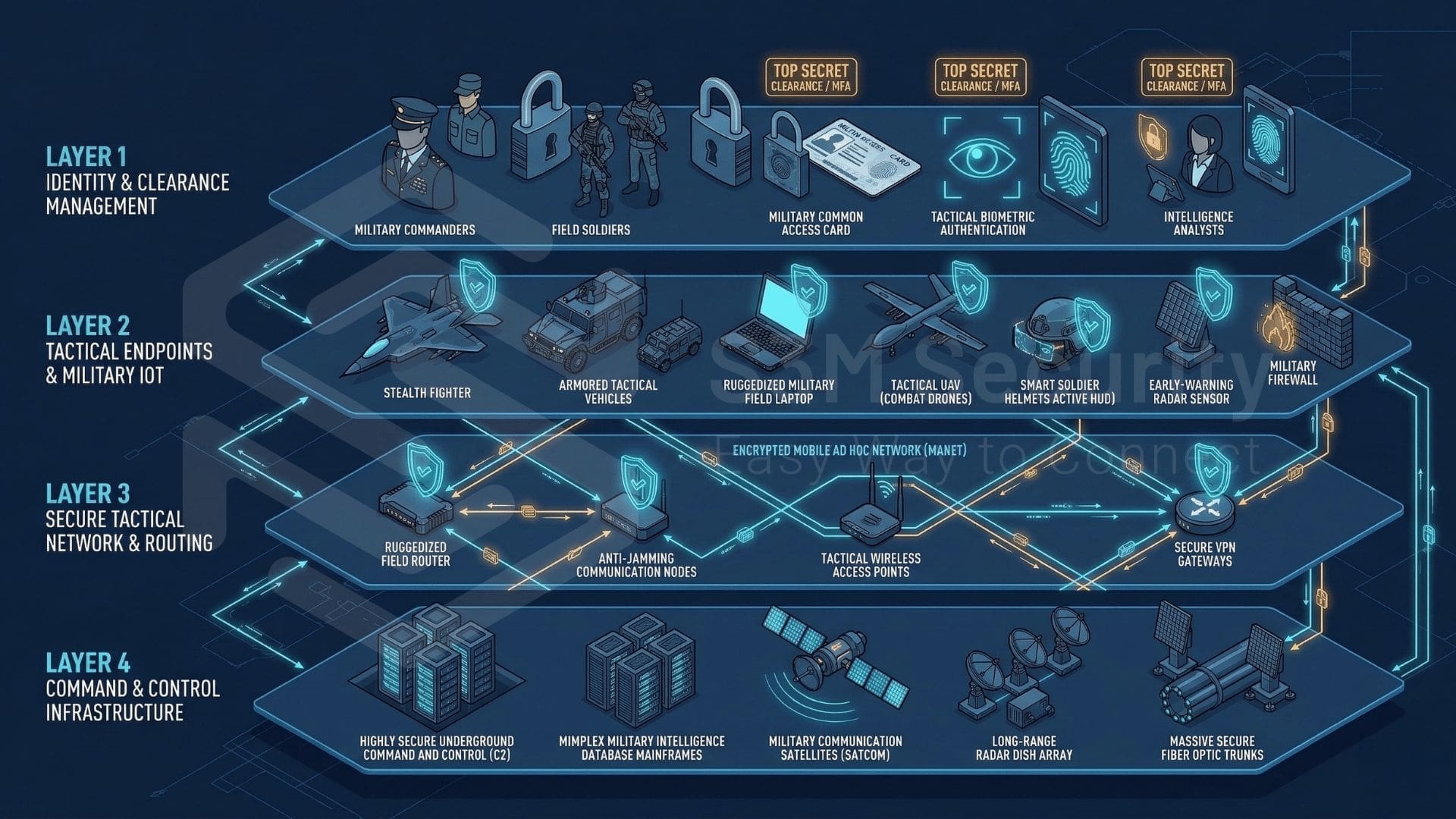
A strong architecture becomes meaningful when it protects real operational environments — from battlefield communications to autonomous defense systems.
REAL WORLD DEFENSE OPERATIONS
Defense Security Scenarios
Security architecture proves its value when protecting real operational environments.
From tactical battlefield communications to autonomous defense systems, modern military infrastructure requires cybersecurity models that function under operational pressure.
Tactical Battlefield Communication
Scenario
Threat
Architectural Response
Operational Impact
Blue Force Tracking Infrastructure
Scenario
Threat
Architectural Response
Operational Impact
Military Drone and Sensor Network Security
Scenario
Threat
Architectural Response
Operational Impact
Defense Contractor Network Access
Scenario
Threat
Architectural Response
Operational Impact
Cross-System Data Protection
Scenario
Threat
Architectural Response
Operational Impact
Smart city cybersecurity must function dynamically under operational pressure — not only under theoretical architectural design.
Operational Defense Security Use Cases
Beyond high-level architecture, defense organizations require security capabilities that function across real operational environments.
From tactical communication security to contractor network isolation, modern defense cybersecurity must support diverse operational scenarios without compromising mission readiness.

Critical Infrastructure Segmentation

Scenario
Threat
Architectural Response
Operational Impact
Security Components
Operational capabilities like these require an integrated security platform designed for defense-scale infrastructure.
Security Architecture Stack for Smart City Infrastructure
Modern smart city environments require a layered cybersecurity architecture capable of protecting distributed networks, public connectivity services, operational technology systems and mobile field operations.
S3M Security solutions integrate seamlessly into municipal infrastructures to provide identity-driven access control, secure public connectivity and encrypted operational communication across citywide digital ecosystems.
Role Description
CityGate synchronizes policy enforcement across districts, access points, data centers, and cloud environments. Public WiFi infrastructure operates as critical civic infrastructure, requiring telecom-grade availability and centralized control.
By clustering authentication and policy engines at scale, municipalities maintain uninterrupted connectivity while enforcing consistent Zero Trust decisions across distributed environments.
Role Description
APNZone secures mobile workforce connectivity across cellular networks. Field officers, maintenance teams, and emergency responders operate beyond traditional network perimeters. Encrypted private APN channels ensure that communication remains policy-enforced regardless of location.
By binding SIM identity and device validation into access control decisions, municipalities extend Zero Trust enforcement into mobile environments without sacrificing operational agility.
Role Description
SpotGate manages structured onboarding and lawful logging across public WiFi deployments. Guest traffic is authenticated, logged, and structurally segmented from operational municipal systems.
In city-wide deployments — including WiFi4EU environments — public access must remain citizen-friendly while maintaining strict architectural separation from internal networks..
Role Description
ConnGuard functions as the identity enforcement core within smart city environments. Every user, device, and system request is validated before network access is granted. Rather than relying on static VLAN structures or IP-based assumptions, policy decisions follow verified identity attributes.
In distributed municipal networks — where public WiFi users, contractors, and internal systems coexist — continuous authentication ensures that trust is dynamically reassessed. This prevents lateral movement across departments and districts.
A layered architecture only proves its value when it operates under real-world pressure. The following scenarios illustrate how identity-driven enforcement reshapes municipal cybersecurity outcomes.
Strategic Security Outcomes
Identity-driven network control enables municipalities to operate complex digital infrastructure securely while maintaining operational agility and citizen accessibility.

Unified Security Control Plane

Secure Vendor and Partner Access

Operational Continuity
