Energy Infrastructure Cybersecurity
Secure Energy Infrastructure with Identity-Driven Zero Trust
Protecting Smart Grids, SCADA Systems and Distributed Energy Networks
Modern energy infrastructure is no longer centralized.
It operates across power plants, substations, renewable energy sites and remote field assets — all connected through complex IT and OT networks.
This distributed architecture creates critical visibility gaps and exposes operational systems to advanced cyber threats.
S3M delivers an identity-enforced Zero Trust architecture designed specifically for energy environments — securing SCADA, ICS and grid infrastructure without disrupting operations.
Energy Threat Landscape
The Expanding Cyber Risk Across Energy Infrastructure
Energy infrastructure is rapidly transforming into a highly distributed, cyber-physical ecosystem.
From centralized control rooms to remote renewable assets, every layer is now interconnected — and exposed.
However, most security architectures were never designed for this level of operational complexity.
As IT and OT environments converge, traditional visibility disappears.
Security teams lose control over who is accessing what, from where, and under which conditions — creating a perfect environment for lateral movement and targeted attacks.
Unmanaged OT & ICS Devices
Thousands of PLCs, RTUs and industrial sensors operate without embedded security, creating invisible entry points across the grid.
Remote & Untrusted Connectivity
Substations, wind farms and field assets rely on external networks, increasing exposure to interception and unauthorized access.
IT–OT Convergence Risks
Bridging corporate IT with operational systems expands the attack surface and enables lateral movement into critical infrastructure.
Lack of Real-Time Visibility
Security teams cannot see or control device identity, posture or behavior across distributed environments.
Regulatory Pressure Escalation
Standards like IEC 62443 and NERC CIP require strict segmentation, traceability and access control across energy systems.
Nation-State Threat Exposure
Energy infrastructure is a primary target for advanced persistent threats (APT) and geopolitical cyber operations.
Energy infrastructure can no longer rely on implicit trust between systems.
Security must shift from network-based assumptions to identity-driven control across every connection, device and access point.
Security Model Breakdown
Why Traditional Energy Security Models Fail
Energy infrastructure was never designed for today’s distributed, interconnected and identity-less environments.
Traditional security models assume control over network boundaries —
but in energy systems, those boundaries no longer exist.
As field assets, SCADA systems and third-party connections expand,
security must operate continuously — not only at the perimeter.
Perimeter-Based Security
Firewalls protect edges — not distributed infrastructure.
Energy networks operate far beyond centralized boundaries.
Static Network Segmentation
VLAN-based segmentation cannot prevent lateral movement across dynamic OT environments.
IP-Based Trust Models
IP addresses do not represent identity.
Devices move, sessions change, trust assumptions break.
Manual Access Control
Human-driven approvals and static policies cannot scale across thousands of distributed assets.
The result is a structural security gap —
where access is granted without continuous verification, and threats move undetected across critical systems.
Security Architecture
Zero Trust Architecture for Energy Infrastructure
Energy infrastructure requires more than isolated security controls.
It demands a continuous, identity-driven security architecture that spans across IT, OT and field environments.
S3M establishes a unified control plane where every connection, device and user is verified, segmented and continuously monitored.
Instead of relying on network location, access decisions are enforced based on identity, device posture and operational context — eliminating implicit trust across the grid.
The result is a structural security gap —
where access is granted without continuous verification, and threats move undetected across critical systems.
Identity Enforcement Layer
Every device, operator and system must be authenticated and authorized before accessing energy infrastructure.
Powered By :
ConnGuard NAC
Endpoint Protection Layer
Critical control systems and operator endpoints are continuously monitored and protected against advanced threats.
Powered By :
EndGuard EPP
Secure Connectivity Layer
Remote substations, renewable assets and field systems connect through encrypted, carrier-grade private networks.
Powered By :
APNZone
Access & Isolation Layer
Third-party vendors and external users are fully isolated from operational systems with controlled access policies.
Powered By :
SpotGate
Architecture Model
Identity-Enforced Zero Trust Across Energy Infrastructure
S3M’s architecture establishes a unified control plane across control centers, corporate networks and remote field assets.
Every connection is validated, segmented and continuously monitored — eliminating lateral movement across energy systems.
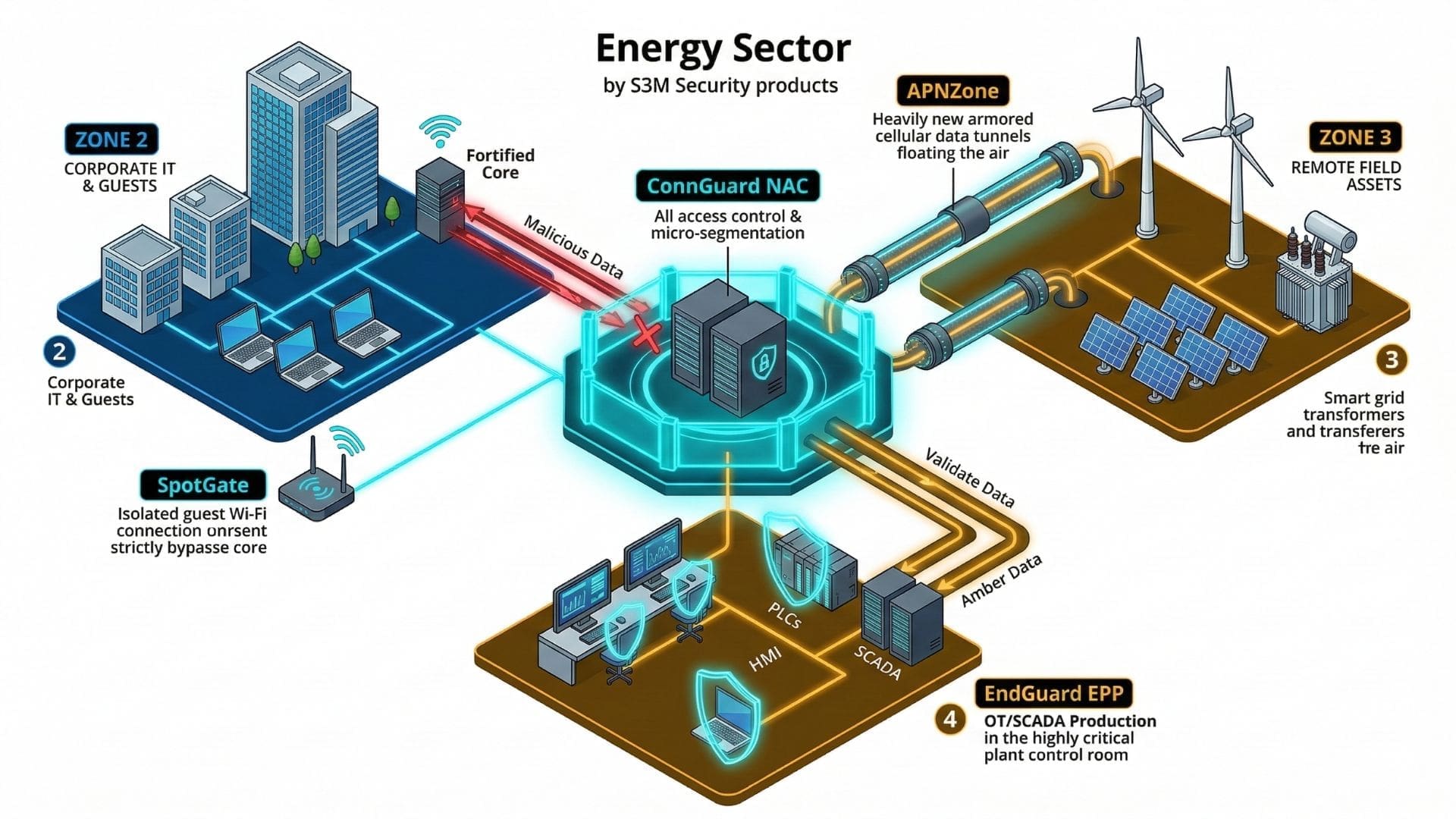
Control Center Security
SCADA and HMI systems are protected through identity-based access and endpoint controls.
IT / OT Segmentation
Corporate IT environments are fully isolated from operational infrastructure.
Secure Field Connectivity
Remote assets connect through encrypted, carrier-grade private networks.
Continuous Monitoring
All traffic and behavior is analyzed in real time across infrastructure layers.
Industry Scenarios
How Zero Trust Secures Energy Operations in Practice
Energy infrastructure security must operate in real-world conditions — across remote assets, third-party access and critical control systems.
S3M’s architecture ensures that every operational scenario is secured through identity-based enforcement and continuous segmentation.
Grid-Wide Network Segmentation
SCENARIO
THREAT
ARCHITECTURAL RESPONSE
OPERATIONAL IMPACT
Control Room Endpoint Security
SCENARIO
THREAT
ARCHITECTURAL RESPONSE
OPERATIONAL IMPACT
Third-Party Vendor Access
SCENARIO
THREAT
ARCHITECTURAL RESPONSE
OPERATIONAL IMPACT
Remote Renewable Energy Connectivity
SCENARIO
THREAT
ARCHITECTURAL RESPONSE
OPERATIONAL IMPACT
Substation Access Control
SCENARIO
THREAT
ARCHITECTURAL RESPONSE
OPERATIONAL IMPACT
OPERATIONAL USE CASES
Operational Security Capabilities Across Energy Infrastructure
Securing energy infrastructure requires more than visibility —
it demands continuous enforcement, real-time control and operational scalability.
S3M enables security teams to manage distributed environments through identity-driven policies and automated response mechanisms.
Dynamic Network Segmentation
Energy systems are segmented in real time based on identity, device posture and operational context — not static network rules.
Prevents lateral movement across IT, OT and field environments.
Identity-Based Access Control
All users, devices and systems are authenticated and authorized continuously before accessing infrastructure.
Eliminates unauthorized access and implicit trust.
Secure Remote Asset Connectivity
Remote substations and renewable assets connect through encrypted private communication channels.
Removes exposure to public network risks.
Real-Time Threat Detection & Containment
Behavioral anomalies are detected instantly and enforced through automated isolation policies.
Stops threats before operational impact occurs.
Third-Party Access Governance
External vendors are restricted to defined systems with full visibility and audit control.
Ensures secure and compliant third-party access
Unified Infrastructure Visibility
All assets across energy infrastructure are monitored through a centralized control plane.
Provides full operational awareness and faster incident response.
Security Architecture Built on Integrated Control Layers
S3M’s Zero Trust architecture is built on modular, interoperable layers that enforce identity, visibility and control across energy infrastructure.
Each layer operates independently — yet together forms a unified security ecosystem.
Access & Isolation Layer
Third-party users and external connections are fully segmented and controlled through policy enforcement.
Secure Connectivity Layer
Remote energy assets connect through encrypted, private and carrier-grade communication channels.
Endpoint Security Layer
Operational endpoints and control systems are protected through behavioral monitoring and threat prevention.
Identity & Access Control Layer
All devices, users and systems are authenticated and continuously validated before accessing infrastructure.
Security is no longer a collection of isolated tools.
It is an integrated architecture where identity, connectivity and control operate as a unified system.
Business Impact of Identity-Driven Energy Security
S3M’s Zero Trust architecture transforms energy cybersecurity from a reactive function into a strategic operational advantage.
Organizations gain not only protection — but also visibility, resilience and long-term scalability.
Scalable Security Architecture
Reduced Attack Surface
Operational Continuity
Regulatory Compliance Alignment
Elimination of Lateral Movement
Complete Infrastructure Visibility
Energy security is no longer just about protection —
it is about ensuring resilience, continuity and control across an increasingly complex infrastructure.
Frequently Asked Questions
How does Zero Trust architecture help protect energy infrastructure?
Why is visibility across energy networks important for cybersecurity teams?
How can energy providers prevent cyber attackers from spreading across networks?
What role does compliance play in energy cybersecurity strategies?
What are the benefits of centralized network security management in the energy sector?
How can energy companies protect critical infrastructure networks?
Why is network segmentation important in energy sector cybersecurity?
How does Network Access Control improve security in energy facilities?
How can energy organizations secure remote access for engineers and contractors?
How do energy companies secure industrial IoT devices?
Secure Your Energy Infrastructure Before It Becomes a Target
Energy systems are no longer isolated.
They are connected, exposed and continuously targeted.
Take control of your infrastructure with identity-driven security built for modern energy environments.