
Endpoint Security Platform
EndGuard Endpoint Security Platform
Built for Regulated & High-Trust Industries
Modern enterprises operate under strict regulatory, operational and security obligations. EndGuard is designed to support these environments by delivering identity-driven endpoint control, continuous compliance validation and infrastructure-level security enforcement.
Organizations operating in regulated sectors must maintain complete visibility over devices, users and access behavior across distributed networks. EndGuard enables security teams to enforce policy-driven endpoint governance while maintaining operational continuity and regulatory readiness.
Vendor-agnostic • Telecom-integrated • Zero Trust enforced
The Structural Risk Behind Enterprise Endpoint Expansion
Modern enterprises now operate thousands of endpoints across distributed environments — corporate laptops, remote workforce devices, contractor systems, and privileged administrative workstations.
While this expansion enables agility and productivity, it also introduces an invisible security gap.
Traditional endpoint protection tools were designed for static networks and predictable device behavior.
In today’s hybrid enterprise infrastructure, endpoints continuously move between networks, identities change, and device security posture becomes difficult to verify in real time.
Without continuous validation of device identity and security posture, a single compromised endpoint can quickly become the entry point for ransomware, credential theft, or lateral movement inside critical infrastructure.
Trust Assumptions
Traditional endpoint security solutions assume that devices inside the corporate network are trustworthy. In modern hybrid infrastructures this assumption breaks down, allowing compromised devices to operate without verification.
Lateral
Exposure
Once a single endpoint is compromised, attackers can move laterally across systems and identities. Without continuous device validation, internal network movement often remains invisible to security teams.
Ransomware Entry
Endpoints remain the most common entry point for ransomware attacks. Phishing emails, malicious downloads and infected removable media frequently compromise user devices before detection occurs.
Enterprise security architectures must move beyond passive endpoint protection toward identity-driven device validation and automated threat containment.
ENDGUARD SECURITY ARCHITECTURE
Identity-Driven Endpoint Security Architecture
Enterprise endpoint protection must move beyond signature-based detection and static device trust models.
EndGuard introduces an identity-driven endpoint security architecture where every device is continuously validated before it can interact with enterprise infrastructure.
By combining device identity verification, posture validation, threat detection and automated containment, EndGuard ensures that compromised endpoints cannot silently operate inside corporate networks.
This architecture transforms endpoint protection from a reactive security layer into a continuous trust verification system.
Device Discovery
EndGuard continuously discovers and identifies all endpoints connected to the enterprise environment, ensuring that unmanaged or unknown devices cannot operate without visibility.
Identity Validation
Every endpoint is validated through identity-driven security controls that bind users, devices and security posture before granting network interaction.
Threat Detection
Behavior-based threat detection continuously monitors endpoint activity, identifying suspicious behavior patterns and preventing malicious processes from executing.
Automated Containment
When a compromised endpoint is detected, EndGuard automatically isolates the device and restricts access to prevent ransomware spread or lateral movement.
IDENTITY ENFORCEMENT
Continuous Endpoint Identity Verification
Modern enterprise environments can no longer rely on static device trust.
Endpoints constantly change location, security posture and network context.
EndGuard enforces continuous identity verification by validating both the device and the user before allowing interaction with enterprise infrastructure.
By binding device fingerprinting, user authentication and security posture signals into a unified trust model, EndGuard prevents compromised endpoints from silently operating inside corporate networks.
EndGuard establishes a persistent identity layer for enterprise endpoints.
Instead of trusting devices based solely on network location, the platform continuously evaluates identity signals including hardware fingerprinting, user authentication context and device security posture.
Every endpoint interaction with enterprise infrastructure is verified through this identity layer, ensuring that only compliant and authenticated devices can access sensitive resources.
If a device fails identity verification or posture validation, access is immediately restricted and the endpoint can be isolated automatically.
Device Fingerprinting
EndGuard identifies each endpoint through hardware-level fingerprinting, preventing unknown or spoofed devices from interacting with enterprise infrastructure.
User-Device Binding
User identity is securely linked with device identity to ensure that only authorized users can operate enterprise endpoints.
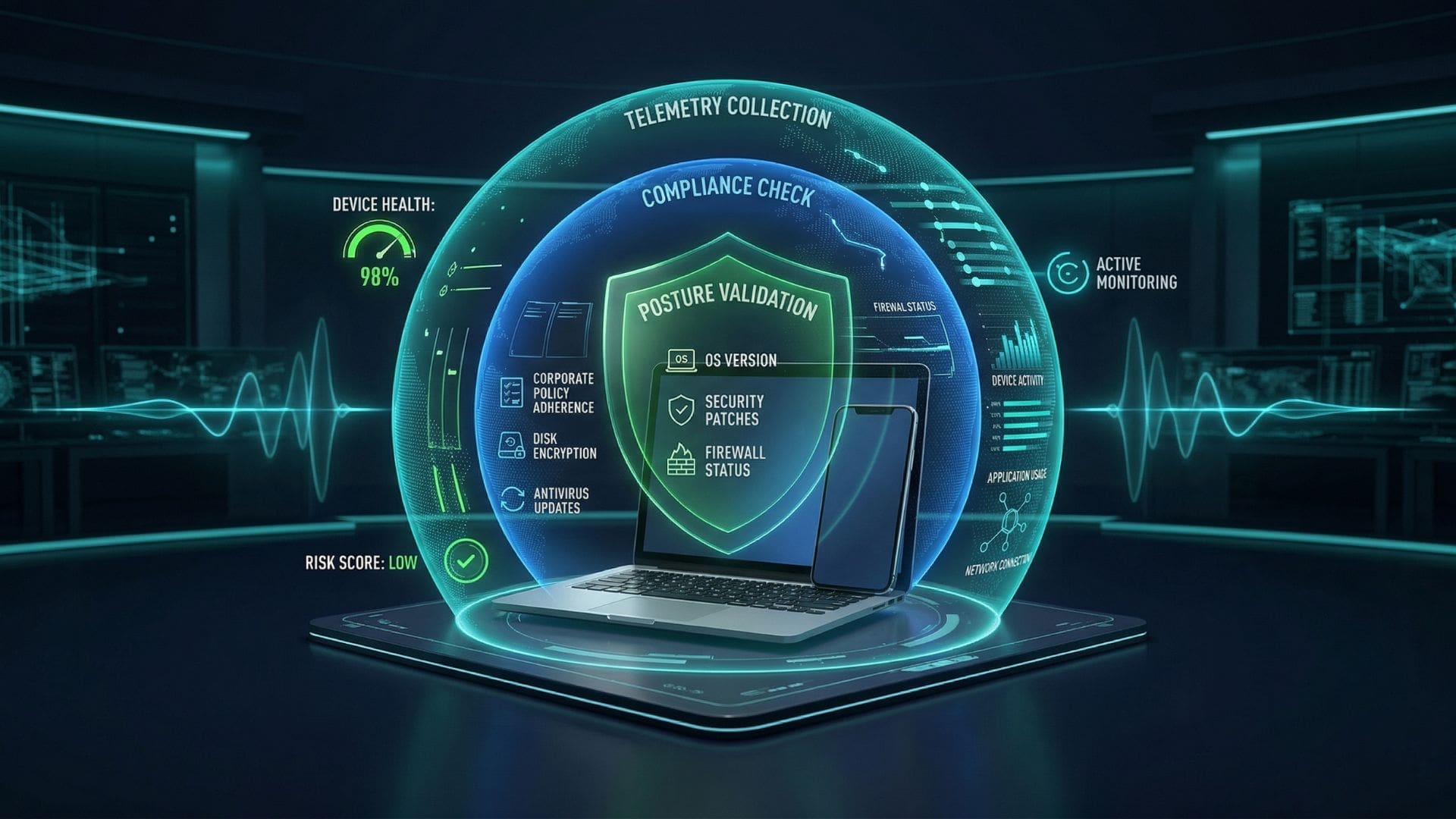
Security Posture Validation
Endpoints are continuously evaluated for security posture compliance including patch level, threat state and configuration integrity.
Continuous Verification
Identity validation is performed continuously rather than once at login, ensuring that device trust is maintained throughout the session.
By enforcing continuous identity verification, EndGuard eliminates implicit trust from endpoint interactions and significantly reduces the risk of compromised devices accessing critical enterprise infrastructure.
POLICY ENGINE
Dynamic Security Policy Enforcement
EndGuard introduces a dynamic security policy engine designed to continuously enforce security rules across enterprise endpoints.
Instead of relying on static configurations or delayed response mechanisms, the platform evaluates device identity, behavioral signals and security posture in real time.
When anomalies or policy violations are detected, EndGuard can automatically restrict device interactions, enforce security controls or isolate the endpoint from sensitive infrastructure.
This policy-driven architecture ensures that endpoint security remains adaptive, responsive and aligned with enterprise risk management requirements.
Adaptive Policy Evaluation
Security policies dynamically adapt to device identity, user context and security posture signals across the enterprise environment.
Real-Time Policy Execution
Security controls are applied instantly when suspicious behavior or compliance violations are detected.
Automated Endpoint Isolation
Compromised endpoints can be automatically isolated to prevent lateral movement or unauthorized system access.
Granular Policy Control
Security teams can define detailed policies based on device risk level, infrastructure sensitivity and operational context.
By combining identity verification with real-time policy enforcement, EndGuard transforms endpoint protection into an adaptive security control layer that continuously protects enterprise infrastructure.
This automated enforcement model significantly reduces response time, minimizes manual intervention and strengthens the overall resilience of the enterprise security architecture.
OPERATIONAL USE CASES
Real-World Endpoint Security Operations
EndGuard supports real-world enterprise security operations where endpoint visibility, device identity verification and automated policy enforcement must operate continuously across distributed infrastructure.
The platform enables security teams to identify unmanaged devices, enforce compliance policies and respond automatically when suspicious endpoint behavior is detected.
Field Workforce Security
Smart Meter Security
SCADA Protection
Enterprise Guest Access
Stadium & High-Density Events
Smart City WiFi
By combining continuous endpoint discovery, identity validation and automated security response, EndGuard enables organizations to maintain real-time control over endpoint activity across complex enterprise infrastructures
SECURITY SCENARIOS
How EndGuard Prevents Endpoint-Driven Security Breaches
Enterprise attacks increasingly originate from compromised or unmanaged endpoints.
A single infected device can enable lateral movement, credential theft, and infrastructure compromise if security controls rely solely on traditional network defenses.
EndGuard establishes continuous endpoint identity verification and automated security policy enforcement, ensuring that risky devices cannot interact with enterprise infrastructure without validation.
Automated Threat Containment
SCENARIO
THREAT
ENDGUARD RESPONSE
OUTCOME
Shadow IT Device Discovery
SCENARIO
THREAT
ENDGUARD RESPONSE
OUTCOME
Unauthorized Device Access Attempt
SCENARIO
THREAT
ENDGUARD RESPONSE
OUTCOME
Endpoint Security Policy Violation
SCENARIO
THREAT
ENDGUARD RESPONSE
OUTCOME
By automatically detecting and responding to endpoint threats, EndGuard enables organizations to prevent attacks from escalating into larger security incidents.
INFRASTRUCTURE INTEGRATION
Built to Integrate with Enterprise Security Infrastructure
Enterprise environments consist of complex infrastructure layers including identity platforms, endpoint security tools, network security systems and cloud infrastructure.
EndGuard is designed to integrate seamlessly into existing enterprise environments without requiring disruptive architectural changes.
Through identity-driven access control and continuous device validation, EndGuard operates as a security enforcement layer across enterprise infrastructure while remaining compatible with existing technology stacks.
Identity Platforms
EndGuard integrates with enterprise identity providers to ensure that endpoint identity and user identity are continuously validated before devices interact with enterprise infrastructure.
Endpoint Security Platforms
Existing endpoint protection tools can share device security posture signals with EndGuard, enabling identity-driven access control based on device health and threat intelligence.
Network Security Systems
EndGuard operates alongside firewalls and network security infrastructure, adding an identity-based enforcement layer that validates device trust before allowing network access.
Cloud Infrastructure
EndGuard extends device identity validation to hybrid and multi-cloud environments, ensuring consistent endpoint security across distributed infrastructure platforms.
Works with Leading Enterprise Security Platforms










By integrating seamlessly with existing enterprise infrastructure, EndGuard enables organizations to strengthen endpoint security without replacing their current technology stack.
Security teams gain centralized visibility and control over device trust across on-premise and cloud environments.
STRATEGIC GOVERNANCE
Strengthening Security Governance Across Enterprise Endpoints
Modern enterprise security requires continuous visibility and governance across all endpoints interacting with corporate infrastructure.
Traditional perimeter defenses are no longer sufficient to control device access, enforce policy compliance, and prevent unauthorized endpoint activity.
EndGuard enables security teams to implement identity-driven governance policies that continuously validate endpoint trust and enforce security controls across the enterprise environment.
Unified Security Control Plane
Regulatory Compliance Enablement
Operational Continuity
Secure Workforce Mobility
Scalable Security Governance
Continuous Infrastructure Visibility
Built for Regulated & High-Trust Industries
Modern enterprises operate under strict regulatory, operational and security obligations. EndGuard is designed to support these environments by delivering identity-driven endpoint control, continuous compliance validation and infrastructure-level security enforcement.
Organizations operating in regulated sectors must maintain complete visibility over devices, users and access behavior across distributed networks. EndGuard enables security teams to enforce policy-driven endpoint governance while maintaining operational continuity and regulatory readiness.


Regulatory Compliance Support
EndGuard supports regulatory frameworks that require strict control over endpoint access, identity verification and infrastructure visibility.
Zero Trust Security Model
The platform enforces a Zero Trust security model where every device and user interaction is continuously verified before accessing enterprise systems.
Identity-Driven Access Control
Endpoint access decisions are based on identity validation, device posture verification and contextual security policies.
Infrastructure-Level Visibility
Security teams gain full visibility over endpoints, network interactions and device activity across the entire infrastructure.
Continuous Device Governance
EndGuard continuously monitors endpoint posture and automatically enforces security policies when devices fall out of compliance.
Enterprise Security Architecture
The platform integrates seamlessly into enterprise infrastructure environments, supporting scalable and resilient security architecture.
Frequently Asked Questions About EndGuard
Enterprise security leaders evaluating endpoint security platforms require clarity on architecture, integration, and operational impact. These frequently asked questions address how EndGuard delivers identity-driven endpoint control, continuous compliance enforcement, and Zero Trust security across modern infrastructure environments.
How does EndGuard handle threats?
Does EndGuard support compliance?
Can it integrate with existing systems?
Is EndGuard scalable?
How is deployment handled?
What visibility does EndGuard provide?
What is EndGuard?
How does EndGuard enforce Zero Trust?
What problems does EndGuard solve?
Can EndGuard detect unknown devices?
EndGuard is designed to provide full visibility and control over endpoint behavior while maintaining operational continuity. For organizations operating in complex and regulated environments, it delivers the confidence required to enforce security policies without compromising business agility.
Security Architecture Consultation
Design a Secure Endpoint Access Architecture
EndGuard enables organizations to establish identity-driven endpoint security across distributed infrastructure environments. Gain full visibility, enforce continuous compliance and eliminate unauthorized access risks with a scalable Zero Trust architecture.
Work with our security experts to design an endpoint security strategy aligned with your operational and regulatory requirements.
Trusted by enterprise security teams across critical infrastructure environments.